


Keru Wang

About Me

headshot

I am a 4th-year PhD candidate at NYU Courant proudly supervised by prof. Ken Perlin. My research interests evolves from mixed reality and multimodal interaction design toward human–AI collaboration and understanding alignment. My current work investigates proactive AI agents that interpret user needs from interaction context. I envision a future where intelligent systems share mutual understanding with humans and engage as collaborative partners rather than passive tools. Building on my background in mixed reality, AI, robotics, and mixed-method research, I bring strong skills in prototyping and evaluating interactive systems. My work has led to demos and publications at top-tier venues including SIGGRAPH, UIST, VRST, TEI, and DIS.
Selected Projects

* Equal Advising    🏆 Best Paper Award
Project Thumbnail
An Investigation of Proactive AI Agents for Reducing Idea Stagnation in Group Brainstorming
Keru Wang, Pincun Liu, Saining Xie, Ken Perlin

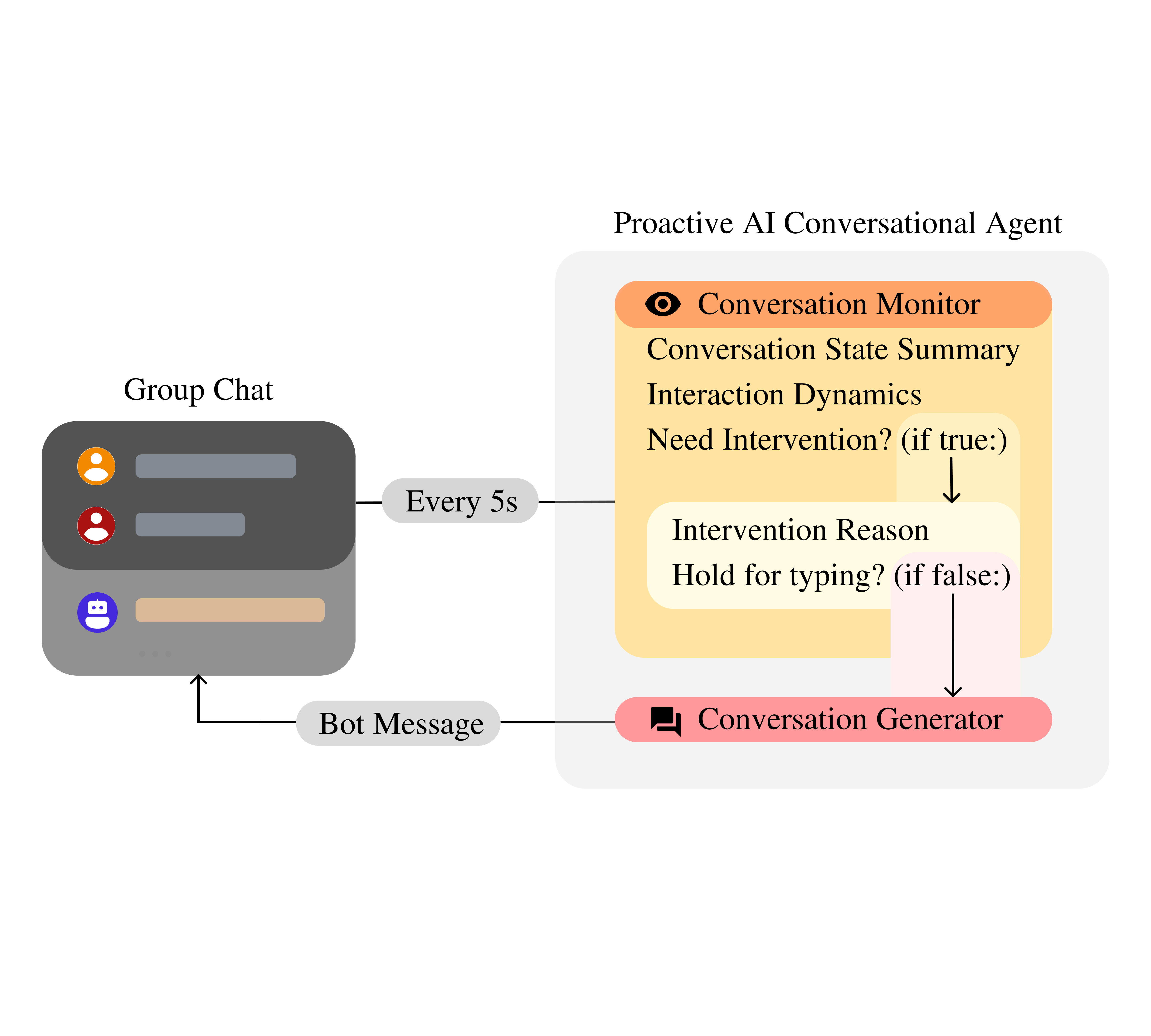
We designed a proactive AI agent that monitors group brainstorming and intervenes at opportune moments to counter idea stagnation. Through two user studies with 18 participants, we found that the proactive agent boosted idea generation, depth, and novelty compared to a reactive baseline, though users still preferred reactive support for its greater sense of control.

Project Thumbnail
Should I Speak Up? Aligning Proactive AI Interventions with Human Expectations in Group Brainstormin
Keru Wang, Pincun Liu, Saining Xie, Ken Perlin

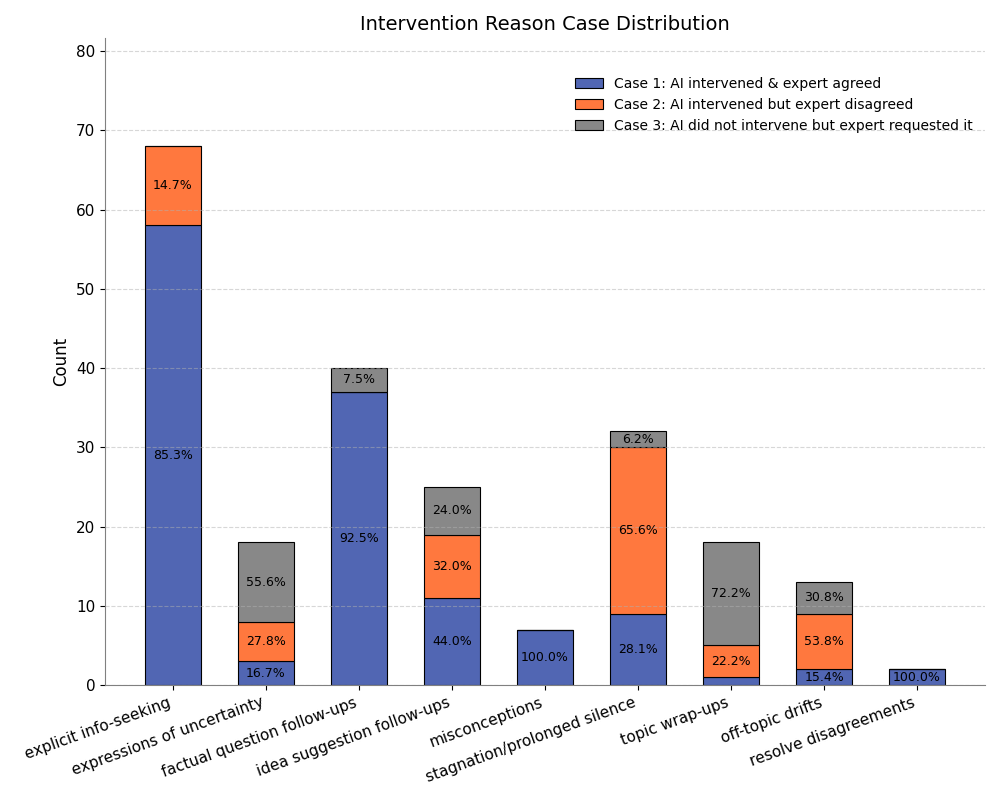
We explore how proactive AI agents can step in at the right moments to keep group brainstorming productive and natural. Using a custom LLM system that monitors discussions and explains its reasoning, we compared its timing judgement to expert evaluations. The study uncovers what makes AI interventions feel helpful versus disruptive, guiding the design of more intuitive and collaborative AI partners.

Project Thumbnail

Flying Together: Human-Guided Immersive Shared Control for Aerial Robot Teams in Unknown Environments
Lou De Bel-Air, Luca Morando, Ruitao Chen, Keru Wang, Benjamin Jarvis, Charbel Toumieh, Yang Zhou, Ken Perlin, Dario Floreano, Giuseppe Loianno

We developed a VR-based shared control framework that allows operators to guide teams of drones in complex, unknown environments. A motion-primitive planner integrates real-time user input to generate collision-free trajectories, while an admittance controller enables flexible human influence. Experiments show that this immersive, human-in-the-loop approach enhances obstacle avoidance, coordination, and operator efficiency.

Project Thumbnail
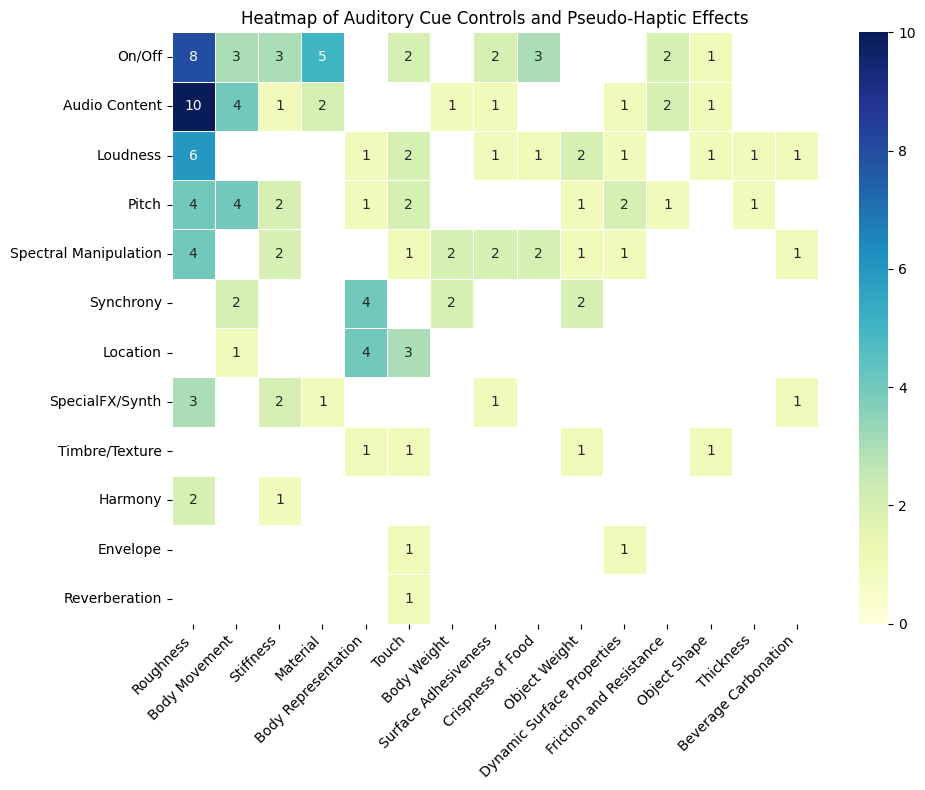
Audio-influenced Pseudo-haptics: A Review of Effects, Applications, and Research Directions
Keru Wang, Yi Wu, Pincun Liu, Zhu Wang, Agnieszka Roginska, Qi Sun, Ken Perlin

This survey explores how auditory cues can evoke pseudo-haptic sensations, offering a cost-effective alternative to traditional haptic devices. We review existing research on audio-influenced pseudo-haptics, summarize mappings between sound and touch perception, and outline future opportunities for creating more immersive and accessible interactive systems.

Robotecture: A Modular Shape-changing Interface Using Actuated Support Beams
Yuhan Wang, Keru Wang, Zhu Wang*, Ken Perlin*

Robotecture is a scalable, cost-efficient shape-changing system using modular actuated beams to create dynamic surfaces and enclosures. Its flexible, space-efficient design enables applications ranging from tabletop displays and smart storage systems to smart architecture.

🏆 Generative Terrain Authoring with Mid-air Hand Sketching in Virtual Reality
Yushen Hu, Keru Wang, Yuli Shao, Jan Plass, Zhu Wang*, Ken Perlin*

We present a VR-based terrain generation system that uses hand gestures and a generative model for fast landscape prototyping. Users draw and modify mid-air strokes to outline shapes, and a Conditional GAN, trained on real terrains' height maps, generates realistic landscapes blending user input with training features.

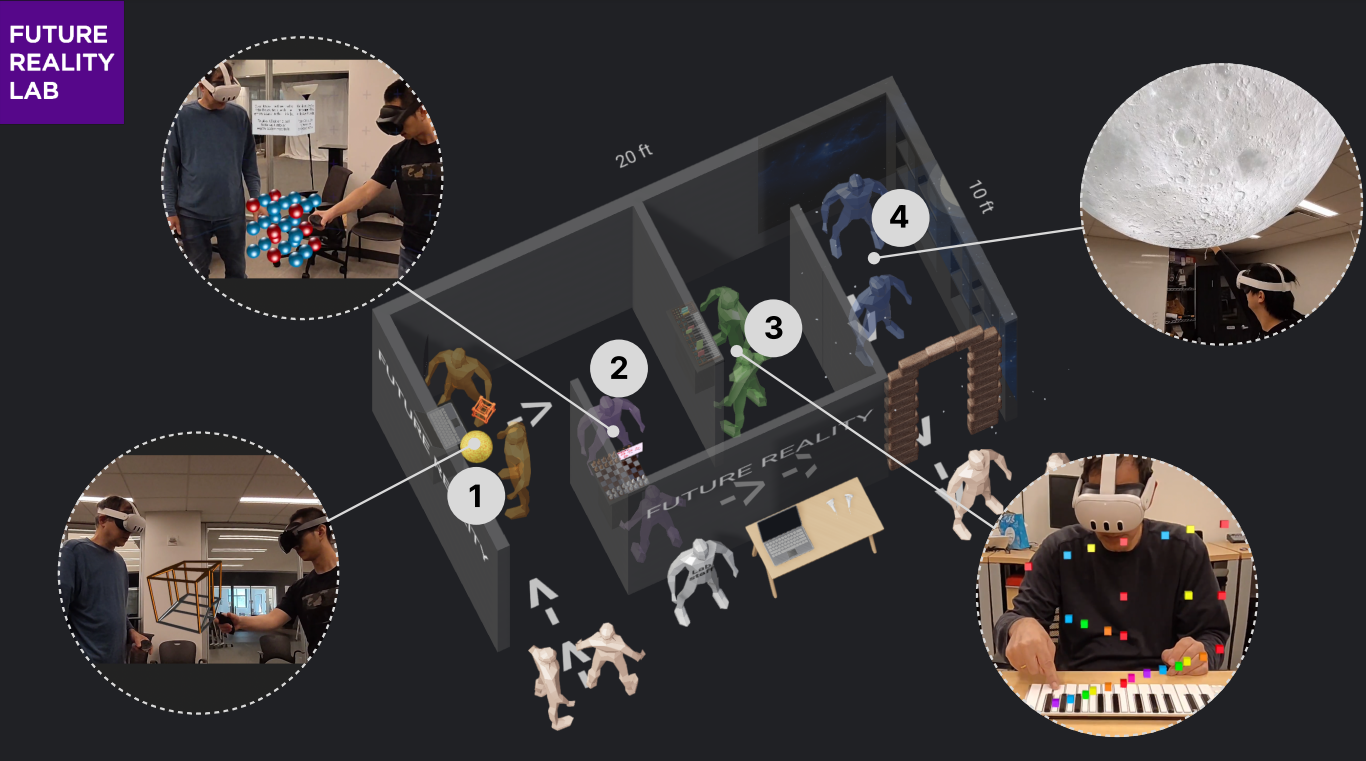
A Collaborative Multimodal XR Physical Design Environment
Keru Wang, Pincun Liu, Yushen Hu, Xiaoan Liu, Zhu Wang, Ken Perlin

Our collaborative XR system integrates physical and virtual design spaces, superimposing visual modifications on physical objects via video passthrough. With multimodal inputs, real-time object tracking, and 3D annotations, it accelerates design iterations for digital prototyping.

“Push-That-There”: Tabletop Multi-robot Object Manipulation via Multimodal 'Object-level Instruction'
Keru Wang, Zhu Wang, Ken Nakagaki, Ken Perlin

The system lets users intuitively use 'object-level' instructions to control a multi-robot setup to manipulate tabletop objects via gestures, GUI, tangible inputs, and speech. Robots collectively execute commands through a generalizable algorithm, enabling high-level, object-focused multimodal interactions.

Project Thumbnail
A Spatial Audio System for Co-Located Multi-Participant Extended Reality Experiences
Yi Wu, Agnieszka Roginska, Keru Wang, Zhu Wang, Ken Perlin

This paper presents the ongoing development of a spatial audio system for co-located, multi-participant, extended reality (CMXR) experiences. By integrating spatial audio and informative auditory displays, the system can enhance the sense of immersion and presence among participants and facilitate collaboration.

Asymmetrical VR for Education
Keru Wang, Zhu Wang, Ken Perlin

We developed a system that allows non-VR instructors to use hand-held devices, like smartphones and tablets, to explore VR content and interact with fully immersed students. Instructors can observe the VR environment, switch between students’ views, and interact within the VR world, while students view real-time video streams of both the physical space and the instructor.

Mixed Reality Collaboration for Complementary Working Styles
Keru Wang, Zhu Wang, Karl Rosenberg, Zhenyi He, Dong Woo Yoo, Un Joo Christopher, Ken Perlin

Our project combines immersive VR, multitouch AR, real-time volumetric capture, motion capture, robotically-actuated tangible interfaces at multiple scales, and live coding, in service of a human-centric way of collaborating.

GazeChat: Enhancing Virtual Conferences with Gaze-aware 3D Photos
Zhenyi He, Keru Wang, Brandon Yushan Feng, Ruofei Du, Ken Perlin

GazeChat is a remote conferencing system that uses gaze-aware 3D profile photos to enrich online conversations. Through webcam-based gaze tracking and neural rendering, GazeChat redirects participants' gaze to accurately reflect who they’re looking at, enhancing communication and engagement.